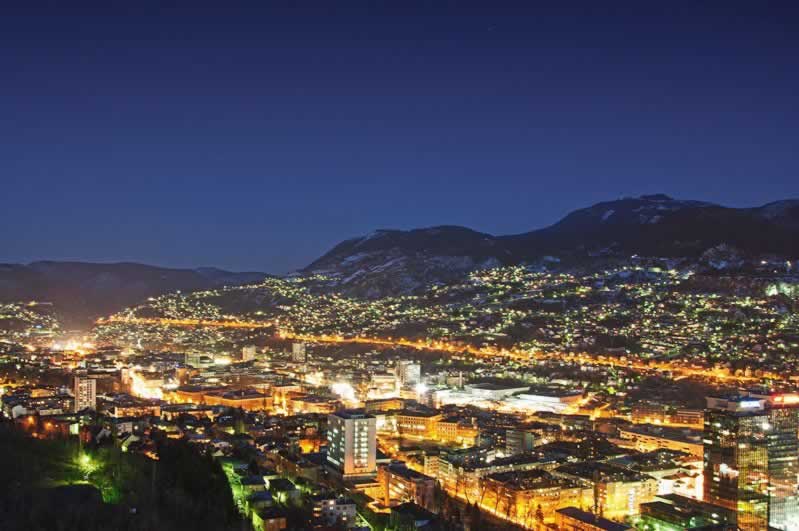
Sarajevo,
photo by Samir Misira
Guide to Sarajevo
Ethnographic style
- Guide to drinking coffee in Sarajevo
- Sarajevo: Café Raja Culture
- It’s HOW You Drink the Coffee – Tips on Enjoying Sarajevo
- Balkan’s Heroes: Bosnia’s Papak
- A Brief Guide to Sarajevo's Local Traditions
Guide to Sarajevo
Guide to the coffeehouses of Sarajevo
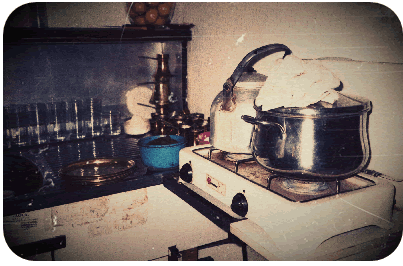 You can find coffeehouses, true Bosnian coffeehouses everywhere in Sarajevo, although most famous are only to be found in the old part of the city. The only problem is that it is sometimes hard to identify them.
They differ from ordinary coffeehouses in that they serve Bosnian coffee, better known elsewhere as Turkish coffee. They serve it in a unique way: on small tray containing a small handless cup called fildžan, a small džezva (Turkish coffee pot) big enough for double serving of coffee, and a cube of sugar. And of course a glass of water; sometimes there is also Turkish Delight (a jelly- like confection flavored with rosewater, walnut or vanilla). Prices in these coffeehouses are significantly lower than elsewhere.
The same tradition continues from Ottoman period
 Bosnian coffeehouses follow the style of coffeehouses from the Ottoman period, which in Bosnia and Herzegovina lasted for over 400 years. The first coffeehouse in Sarajevo opened in 1592, at a time when the new beverage was only just becoming known elsewhere in Europe. This even is believed to be linked to the sixteenth-century expansion of the Ottoman Empire, under which most of the Balkan Peninsula fell; the Ottoman soldiers brought coffee with them as an indispensable part of their supplies.
Be that as it may, today's coffeehouses are rather different from the Ottoman coffeehouses. The latter were small low-ceilinged premise, if the coffeehouse was in town, the roof usually extended far into the street. The walls of some coffeehouses were often plastered with price lists and newspapers, and sometimes the odd painting would hang there. Along the walls stood ibriki (water jugs with tubular spout), džezve, tin boxes containing pounded coffee and sugar, and bottles containing rosewater and lemonade. The kahvedžija made coffee over an open fire in small brass pots. The walls were lined with wooden benches covered with cushions; it was customary for a bench in one of the corners to have a higher and more beautiful cushion, reserved for the aga or beg, who would visit the coffeehouse every day. Patrons sat cross-legged on the benches and smoked. They could also spend the night on the benches for the price of a cup of coffee. (For more about coffeehouses in this period and about coffee culture, see Dr. Božidar Jezernik's book Kava).
Today's coffeehouses often have drawings and photographs of the Ottoman period on their walls. These usually show street life, although portraits are also common – for example an old man with a turban smoking a long-stemmed pipe or chibouk. Shelves hold items similar to those they held in the past, with a difference that today they are no longer used. Even the musical instrument known as the saz, used to play the traditional love songs known as sevdalinke, is only found on the wall, since live music is unfortunately a rarity in these coffeehouses. Although some Bosnian coffeehouses remain faithful to tradition even in their furnishings, for example Bosanska Kahvana in Male Daire in the Baščaršija district, where you sit on wooden benches or sećije covered with patterned rugs, this is more the exception that the rule. Today most of these coffeehouses opt for gold-colored chairs and marble tables, in other words a style that became popular somewhere back in the 1980's. But the choice of furnishings is not a problem: the atmosphere is far more important.
An interesting atmosphere reigns in traditional coffeehouses
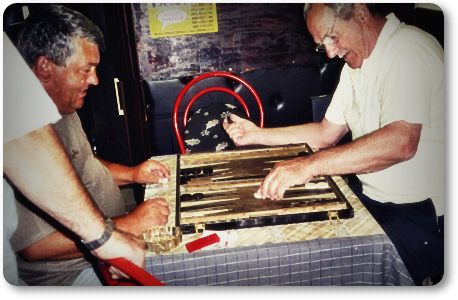 In these coffeehouses silence usually reigns and all you can hear is the conversation of the patrons. This in itself undoubtly helps create a special mood. Then there is the fact that most of the patrons are men, as are most of the staff (usually owners and their sons). This of course does not mean that women are not allowed to enter, but the patriarchal tradition certainly had (and still has) an influence here. In some coffeehouses chess is played, although in Sarajevo you are more likely to come across people playing tavla, a game played in the streets of Baščaršija district and in more traditional establishments.
Bosnian coffeehouses do not serve alcohol. Coffeehouses such as Bosanska Kahvana and Kod Bega are usually frequented by patrons who observe the Islamic tradition, and, as one coffeehouses owner says, if they were to serve alcohol, they would lose the custom of these patrons. These coffeehouses are very much daytime establishments, perhaps also because there is no alcohol compelling people to stay there long into the night.
We might also mention the toilets, which are often of the long-drop type. A plastic bottle of water is usually placed next on them. This may seem unusual to some foreigners, but washing in a toilet after doing one's business is connected with Islamic prescriptions. And so it sometimes happens that there is no toilet paper in them. Toilets with bottle of water can also be found in other establishments which do not call themselves Bosnian coffeehouses but still stick to the Islamic tradition: for example Čardak and ZemZem, or the popular and trendy Fratelli in Ciglane, the Beverly Hills of Sarajevo.
Traditional drinks not found anywhere else
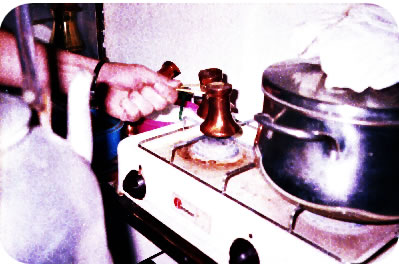 The way in which Bosnian coffee is made is interesting in itself. The waiter takes two small džezve into which he first places three spoonfuls of coffee and then covers with boiling water from another pot. He then places the džezve on a gas ring and waits for the froth to rise. He then adds enough hot water to fill the džezve to the top – and serves.
Bosnian coffeehouses also offer tea, lemonade and still and carbonated fruit juices. Some also serve sok od smreke (pronounced with a long, open »e«), which along with Bosnian coffee can be considered a symbol of traditional coffeehouses. This beverage made from juniper berries and water, made by fist washing of juniper berries and then leaving them to soak in water for an hour or two. A kilogram and a half of juniper berries will be place in ten liters of water and left for ten days. Some Bosnian coffeehouses also serve salep – a hot beverage made from powdered orchid root. Drunk mostly in winter, salep is said to be excellent for the respiratory organs. It is served in Kod Bega and Čardak, where they also have pounded coffee. (Kod Bega is without a doubt my favourite coffeehouse, mainly because of the clientele and the owner.) As regards pounded coffee, it is made using dibek, a type of pestle. In the past this was the usual way to prepare coffee, but today it is more a reminder of days gone by, since it has been almost entirely supplanted by ground coffee. By the way: you can buy pounded coffee in a little shop close to the Beg's Mosque.
In step with the times, but the atmosphere remains
 Given that Sarajevo is famous as city where West and East meet, we can also sense this dichotomy in some Bosnian coffeehouse. There are coffeehouses which try to follow tradition – and this has actually become a synonym for the East, at least in Bosnia – and others which, although registered as Bosnian coffeehouses, would like to attract a more varied clientele. One traditional coffeehouse, for example, has started to serve espresso too. One might think that this is because of the tourists, although owner denies this. He says that they have to keep pace with times, and that coffee from the machine is part of the progress.
An interesting explanation of this dichotomy was offered by the son of the owner of Tunel (a coffeehouse on the main square in Baščaršija – next to the Sebilj fountain), where they also serve esspresso. He says that Bosnian coffee is usually ordered by those who cling tot tradition, while those who are more Western-minded ordered espresso. That it does not all come down to ideology, however, is illustrated by the fact that the owner, Suljo, only drinks Bosnian coffee, simply because he finds espresso too strong. Nevertheless, one regular coffeehouse-goer described Tunel as follows: »Although perhaps it is not done out exactly like a Bosnian coffeehouse, it is still called a Bosnian coffeehouse. Not even the furniture is really Bosnian. The only music is from the radio, most often tuned to local station, but even more often there in no music at all – but then in this coffeehouse you don't need any.«
The essence is in the atmosphere – and in Sarajevo the atmosphere is truly special.
Originaly published:Adria - In-flight Magazine